
 Shop
Shop Configurator
Generally
Dynamic weather control
With OpenSprinkler there are several ways to dynamically control irrigation:
A) With sensors:
- With a rain sensor
- With a soil moisture sensor (from firmware 2.1.9)
- In combination rain sensor + soil moisture sensor (from firmware 2.1.9)
The sensor control is designed in such a way that irrigation is prevented when a sensor signal is received.
B) With weather-specific method:
- “Zimmerman” method: You specify what corresponds to 100% irrigation. Watering will be increased or decreased based on temperature, humidity and rain from the weather forecast.
- “Automatic rain delay” method: When it rains, the watering program is delayed by an adjustable period of time. However, the duration of watering does not change.
- “Evapotranspiration” method: evaporation values are calculated and the irrigation duration is adjusted accordingly. Watering is shortened on wet days and increased on dry days. More details here: https://de.wikipedia.org/wiki/Evapotranspiration
The weather report is also used for this. The past days are looked at and set for the future.
For all methods, the basic values must be configured with “Calibrate”. Internet access is also required to access the weather report. Unfortunately, it is not possible to tell from the digital weather report whether it is currently raining. Generally, this is stated with probabilities in the form e.g. “Rain today 37%”. It is therefore generally recommended to use a rain sensor.
Important: Before setting a weather method, set your time zone and location correctly! Menu “Edit Options”, then “System”!
1. Zimmerman method
In my experience, you should prioritize the rain; when it rains, you water less or not at all:
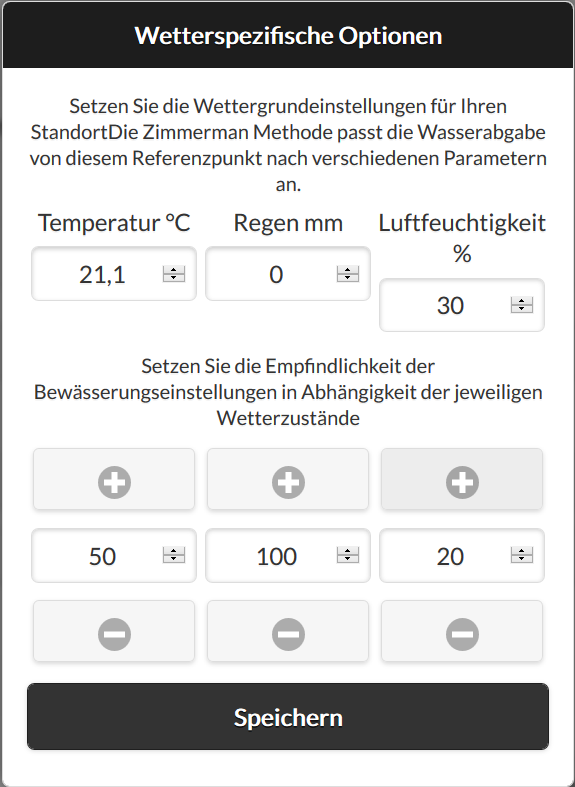
Define what equates to 100% watering:
- Higher temperature, more watering (default 21.1°C)
- More rain leads to less irrigation (rain in mm/m², default 0mm)
- Higher humidity leads to less irrigation (in %, default 30%)
2. Automatic rain delay
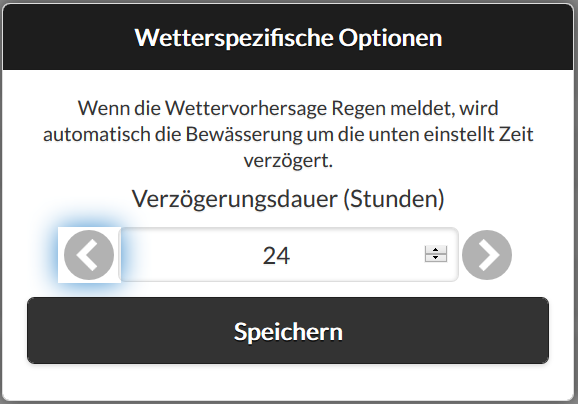
Actually a simple method: If it has rained, the irrigation is “postponed”. You set the “slide time”.
I recommend 24h or 48h. With values like 4h or 8h, the postponed watering takes place at unusual times, who wants to have the lawn watered during the day when you are lying on the lawn?
3. Evapotranspiration
Developed according to the latest agricultural knowledge. Calibration is particularly important here.
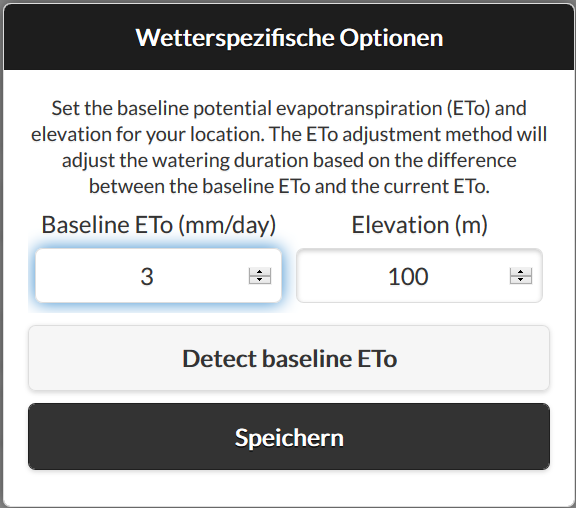
The “elevation” is the height of your garden in m above sea level. If you don't know your exact height, go to the following website: https://www.mapcoordinates.net and read the value from their address.
Then press “Detect baseline ETo”. This calculates the evaporation factor (baseline ETo) based on your location.
You can see the full English description here:
https://openthings.freshdesk.com/support/solutions/articles/5000823370-using-weather-adjustments
ATTENTION: There is a known issue when switching from Zimmerman to Evapotranspiration:
https://OpenSprinkler.com/forums/topic/problems-with-weather-updates-et-method/
The values are not accepted. However, the solution is very simple: simply switch to “Automatic rain delay”, click calibrate, confirm and save. Now the values of the other methods are deleted. Now switch back to Evopotranspiration and calibrate. The values should then be accepted.


Hello admin.
Thanks for the feedback. This function doesn’t exist in “Programs”, right? I run several zones in the program at the same time, which is why the setting in the zones/circles is deactivated.
greeting
Christopher
Hello admin.
I have the Zimmerman method running and the problem is that the programs overlap at greater than 100%. This then leads to a drop in pressure because there are too many water consumers. I have version 2.1.8 running with app version 2.2.5 on a Pi. Are there any design options or a way to get around the problem?
greeting
Christopher
Actually, it is enough to activate the zones “sequentially”, then they do not run at the same time, program starts are then carried out later.
Hello admin.
Thanks for the feedback. This function doesn’t exist in “Programs”, right? I run several zones in the program at the same time, which is why the setting in the zones/circles is deactivated.
greeting
Christopher